 Rana Maalouf

Key Takeaways
- Protranslate offers certified translation services in over 120 languages.
- Protranslate can deliver certified translations within 24 hours.
- A certified translation includes a signed statement from the translator or company confirming accuracy and completeness, while notarization only verifies the identity of the person signing a statement related to the translation.
- You often need a notarized translation for court filings, some government agencies (for immigration or citizenship), and for international use where countries or institutions insist on it for documents like academic transcripts or business contracts.
What is a Certified Translation of an Academic Degree?
A certified translation of an academic degree is just what it sounds like: a precise, word-for-word rendering of your diploma, transcript, or other academic paperwork. It comes with a signed statement from the translator or the translation company. That statement confirms the translation’s accuracy and completeness; it’s a faithful representation of your original academic record.
Such translations are vital. You’ll need them to show your academic qualifications to foreign universities, credential evaluation services, immigration authorities, or even potential employers. They make sure your education achievements are clear and accepted in a new linguistic and administrative setting. They keep your academic history intact.
The certification confirms the translator is qualified. It means the translated document truly and accurately reflects the original, with no changes or missing parts. This is critical for getting your academic credentials checked and accepted abroad.
Certified Translation Services
Get your documents translated and certified by a professional translator in 120+ languages with 24 hour delivery.
Get a Quote
How to Verify the Authenticity and Certification of a Translated Academic Degree?
Verifying the authenticity and certification of a translated academic degree takes several steps. This ensures institutions and authorities accept it. The main point is to confirm the translation is accurate and the certification statement is legitimate.
First, check the certification statement. It needs to say, clearly, that the translation is complete and accurate. And it must be signed by the translator or a translation company’s authorized person. Look for the translation date, the translator’s or company’s contact info, plus any official seals or stamps. A credible certification statement also lists the translator’s credentials or states they’re good in both the source and target languages.
Next, compare the translated document to the original academic degree. Look for consistency: names, dates, grades, course titles, institution names. If anything’s off, investigate it. Make sure all stamps, seals, and signatures from the original are either translated or clearly noted in the translation.
You can also verify the translator’s credentials. If the certification statement mentions membership in a professional translation group (like ATA in the US, ITI in the UK), check their directory. It often confirms the translator’s status. For company translations, look at their reputation and reviews. Some places even contact the translation service directly to confirm the certification’s validity.
Finally, if the place receiving it—university, evaluation service, or employer—has specific rules for certified translations, make sure you’ve met them. Some need notarization on top of certification. Or translations by sworn translators in certain countries. Always check the receiving institution’s guidelines before you submit anything.
What is a Certified Translation?
A certified translation can be defined as a translated document that has a signed statement by a professional translator or translation company to the effect that the document has been translated fully and accurately. The signed statement also affirms that the document has been translated by a person who has full competency in the original as well as target languages.
This attestation is called a Statement of translation accuracy. This signed attestation indicates the translator or agency’s responsibility for the accuracy of the translation itself. The responsibility for the contents, however, is with the person who owns the document.
A translation will be deemed to be certified when it contains the following:
- A true and complete translation of the source text
- A signed document acknowledging accuracy and completeness
- The translator’s credentials and contact information
The critical difference between an ordinary translation and an authentic one has to do with the presence of this signed certification statement. Ordinary translations can indeed contain correct translations without being authentic.
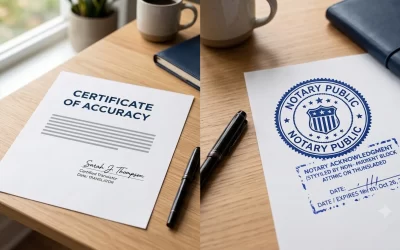
People often think notarizing a translation makes it certified. They’re actually separate processes, each with its own purpose and legal punch. A certified translation is just the translator, or their company, saying the translation is accurate and complete. That certification directly addresses the document’s content.
That doesn’t confirm the translation’s accuracy or quality at all. When a document is notarized, a notary public verifies the identity of the individual who signs the document—typically the translator or a representative of the translation agency—and witnesses their signature. The notary’s job is to confirm the signer is who they say they are, and that they signed willingly. Even if a notarized translation includes a certification, the notarization only authenticates the signer’s identity. This certification directly relates to the content of the translated document. Want to understand these differences better? Check out our article.
Statement of translation accuracy
Statement of translation accuracy: It is an accompanying document that affirms the accuracy of the translation. It typically includes details on company letterheads, with special identification information.
A complete certificate generally covers:
- Translator’s Information – Name, professional background, and contact details
- Accuracy statement: A declaration to confirm if the translator possesses skills in handling both languages to ensure its equivalence in translation.
- Date of completion – The date of finalization of translation.
- Signature
- Handwritten or secure electronic signature
- Stamp or seal – If possible, a stamp from the translator or the translating agency.
- Document identification – Title, date, or reference numbers of the original document
- Intended use (optional) – This may reveal what sort of document it is, for example, for judicial, academic, immigration, or medical use
Documents that Require Certified Translation
When documents are submitted to a foreign authority, the possibility of language limitations restricting proper assessments exists. This can be corrected with certified translations.
Certified translations are commonly requested for documents such as:
- Immigration and visa requirements
- Courthouse filings
- Admittance to government applications
- Adoption cases
Common examples include:
- Birth certificates
– Required for visa applications, residency permits, and civil registration
Document Translation Services
Looking for a Quick and Convenient Way to Get Professional Document Translation Service? Click the Button Below for Our Online Translation Service!
Get a Quote
- Birth certificates – Commonly requested for visa filings, residence permits, and official civil records.
- Marriage certificates – Used in family reunification cases and to confirm a legally recognized relationship.
- Academic documents – Diplomas, transcripts, and certificates reviewed by schools and universities.
- Legal paperwork – Contracts, court rulings, affidavits, and powers of attorney.
- Immigration documents – Background records and civil documents examined by immigration officials
- Business agreements – Contracts and corporate documents used in cross-border business
Translation Certification Criteria
Universities, credential evaluators, and even government bodies expect certified academic degree translations to hit certain marks. It's how they know the translation is accurate and official.
- Qualified Translator or Agency: A professional translator or a reputable translation agency must perform and certify the translation. The translator should be good at both the source and target languages. And, ideally, they’ll know their way around academic terms.
- Verifiable Credentials: The translator or agency should be able to prove their qualifications. Often, this means membership in professional translation groups or official accreditation, if that applies. This lets institutions verify the translator’s skill.
- Complete Accuracy: The translation needs to be a precise, word-for-word copy of the original academic document. No information can be added. Nothing left out. Nothing changed. That includes every bit of text, all numbers, dates, stamps, and seals.
- Correct Formatting: The layout and formatting of the translated document should closely mirror the original. That way, the place getting it can easily compare the translation to the first document.
- Language Proficiency: The translator must possess high proficiency in both the original language of the academic degree and the target language for the translation.
- Subject-Specific Expertise: Translators working with academic degrees need to know their stuff: educational systems, academic terms, and common abbreviations in both cultures. This means course titles, grades, and degree names get translated right.
- Certificate of Accuracy: A signed statement has to come with the translation, saying it’s accurate and complete. Usually, this certificate has the translator’s or agency’s info, an accuracy statement, a date, and a signature.
Sworn, Official, and Certified Translations: Main Differences
Sworn Translation
A sworn translation is the work of a translator who has been officially authorized by a government institution, sometimes by the court. Sworn translators have taken an oath and have the ability to sign the translation using their official seal. Sworn translations have the same validity as the source document in the jurisdiction.
Sworn translations are usually needed for:
- Court submissions
- Government filings
- Citizenship applications
- Overseas academic recognition
It has legal validity, official stamps, and recognition of public institutions.
Official Translation
The phrase “official translation” is commonly used informally. In this case, it might refer to either sworn or certified translation, depending on the regulations within the relevant jurisdictions. Here, the deciding feature is whether it has gained acceptance with the concerned authority.
Certified Translation
The certified translation comes along with an accuracy certification and is not provided by an appointed translator. Although recognized universally, it has equal status as that of a sworn translation in countries that practice sworn translators.
Local Terminology for Certified Translations by Country
Terminology varies by region, and regional requirements include:
United States: Generally known as USCIS certified translation for immigration purposes
France: Traduction assermentée, issued by court-sworn translators
Español: Traducción jurada, de acuerdo con el Ministerio de Asuntos Exteriores
Australia: NAATI-authorized translations
Canada: Regulated translation requirements are at the province level
Switzerland: Translations certified by translators and notarized or attorney-verified
Ireland: Certified translations by recognized professional members
Austria: COURT-CERTIFIED translators authorized by the Ministry of Justice
Germany: Beglaubigte Übersetzung, created by court-approved translators
Russia: Notarial translations involving notarization
Let the Words Lead the Way!
Have your document translated into more than 100 languages by professional translators with just a few clicks without ever stepping a foot in a translation office.
Get a Quote
The Process of Getting an Academic Degree Certified Translation
Getting a certified translation for your academic degree? It's not hard. The process is clear, really, built for precision and official acceptance. Here's how it generally works:
- Upload Your Document: First, upload a clear copy of your academic degree—diploma, transcript, whatever—through an online system. It’s secure. You’ll pick the languages you need, too.
- Get an Instant Price Quote: You’ll see the price right away. It’s based on how long the document is and the languages involved. No surprises. No hidden fees.
- Professional Translation: An expert translator gets your document. They’re a native speaker of the target language. Plus, they know academic fields inside and out. That’s how educational terminology gets translated precisely.
- Quality Review: A second linguist goes over the translation. They check for accuracy, making sure the terms are right and the formatting matches. It has to align perfectly with the original academic document.
- Certification and Delivery: Once it’s done, the translation comes with an official certificate of accuracy. You usually get it as a PDF, ready to send to universities, evaluation services, or other institutions.
What is a Notarized Translation?
In a notarized translation, a notary public is involved to confirm the signer’s identity and to authenticate the signature. The notary’s role is limited to this verification and does not extend to checking the translation’s content.
Notarization for translated documents is typically required in specific scenarios where an official body needs assurance about the identity of the person signing a document related to the translation. A certified translation guarantees the content is accurate. That just confirms the signature is real.
You often need a notarized translation for things like court filings or depositions; the court needs to formally recognize the translator’s declaration. Some government agencies, for immigration or citizenship, also ask for notarized translations. They want the translator’s affidavit officially witnessed. And for international use, notarization is often a must. Many countries or institutions insist on this extra step for documents like academic transcripts or business contracts before they’ll accept them.
Certified Translation vs. Notarized Translation for International Adoption Documents
When you’re dealing with international adoption documents, it’s really important to get the difference between a certified translation and a notarized translation straight. Each does something specific, and often, you’ll need both for the documents to be legally accepted abroad.
For international adoption documents — think birth certificates, consent forms, court orders — a certified translation confirms the translation is accurate and complete. It comes with a signed statement from the professional translator or translation company. This statement says the translated document is an exact, word-for-word copy of the original. That way, all the legal and personal info crosses language barriers accurately, which is vital for the adoption’s legal standing.
On the flip side, a notarized translation means a notary public confirms the identity of the person signing the translation’s certification or an accompanying affidavit. The notary just witnesses the signature and verifies who signed it; they don’t check the translation’s accuracy or quality. With international adoption documents, notarization adds another layer of authentication for the signer’s identity. Some foreign governments or adoption agencies require this to prevent fraud. It’s pretty common for adoption documents to need both: a certified translation for content accuracy, and notarization of the translator’s statement to legally authenticate the signer.
Cost of Certified Translation
Pricing is influenced by the following:
- Document length
- Language pairing
- Subject complexity
- Urgency
Some companies charge by the word, while others by document. This should be asked in advance.
Are Certified Translations of Academic Degrees Accepted Everywhere?
Whether a certified academic degree translation gets accepted often comes down to the specific rules of the place requesting it. A university, credential service, or immigration office — they all have different needs. Sure, certified translations are generally accepted. But standards? They’re not the same everywhere; countries and institutions each have their own.
Most educational places and official groups worldwide take certified translations, especially with a statement of accuracy from the translation service. But some might need more. Like, the translation has to be notarized, or apostilled. Or done by a sworn, court-appointed translator in that country.
Always check the exact needs with the institution or authority where you’re sending your translated academic degree. Always verify. This helps you comply. And you avoid delays in your application.
Self-certification is not normally acceptable for official purposes. A third-party verification by a competent person is required in order to avoid bias.
Frequently Asked Questions About Certified Translations
What is the process for obtaining a certified translation?
The process typically involves uploading your document, receiving an instant quote, professional translation by an expert, a quality review, and finally, certification and delivery of the translated document.
What is the difference between sworn, official, and certified translations?
A sworn translation comes from a translator who’s officially authorized by a government institution, often with an official seal attached, while a certified translation just needs an accuracy statement from a professional translator or agency. ‘Official translation,’ though, is the loose term — it can mean either one, and which applies depends on local regulations and what the authority will actually accept.
What are the ways to get a certified translation?
You’ll get a certified translation by submitting your documents to a qualified professional translation service — online or through a physical office, it’s your call.
How can I verify that my translated academic degree is authentic and certified?
To verify, examine the certification statement for completeness and a signature, cross-reference the translation with the original document for accuracy, check the translator’s credentials, and confirm any specific requirements with the receiving institution.
What information should be included in the certification statement for an academic degree translation?
A signature, the date, contact information for the translator or agency—sometimes the credentials or professional affiliation too—that’s what you’ll find on a certification statement for an academic degree translation, though the part that actually matters is the declaration that it’s accurate and complete.
What should I do if an institution questions the authenticity of my translated academic degree?
When an institution does question authenticity, the first move is to go back and re-verify what that institution specifically requires, since requirements vary; then contact the translation service that provided the certified translation and ask for any additional documentation or, better yet, for direct communication with the institution to confirm the translation’s validity and the translator’s credentials.
Can you get a translated document notarized?
A translated document can be notarized. This usually means a notary public watches the translator sign their certificate of accuracy or an affidavit, confirming the translator’s identity. But the notary doesn’t check the translation’s accuracy.
What exactly does a notary verify on a translated document?
A notary public simply confirms the signer’s identity and watches them sign. Usually, that’s the translator or a rep from their company. But they don’t check the translation’s accuracy, or its quality. That’s not their job. They just verify the signature is real, and the person put it there willingly.
When would you even need a notary for a translated paper?
Court cases, certain immigration forms, international business — that’s where a notarized translation tends to come up, and sometimes a foreign institution will ask for one specifically, which just adds another layer of proof that whoever signed it is actually who they claim to be.
Get a Translation Quote for Your Documents
Do you want a quick and easy way to obtain a professional translation service for your documents? Click on the desired button to access our online translation service!
Get a Quote