
Certified vs. Notarized Translation: Understanding the Differences
What trips people up with official documents crossing language barriers is a pair of terms that get used as if they’re interchangeable: “certified translation” and “notarized translation.” Sure, both exist to make a translated document more credible, but they’re not the same thing and the processes behind them differ, so get the distinction wrong and the requesting authority may hand your paperwork back — a real risk with immigration filings or legal proceedings, among others.
What Constitutes a Certified Translation?
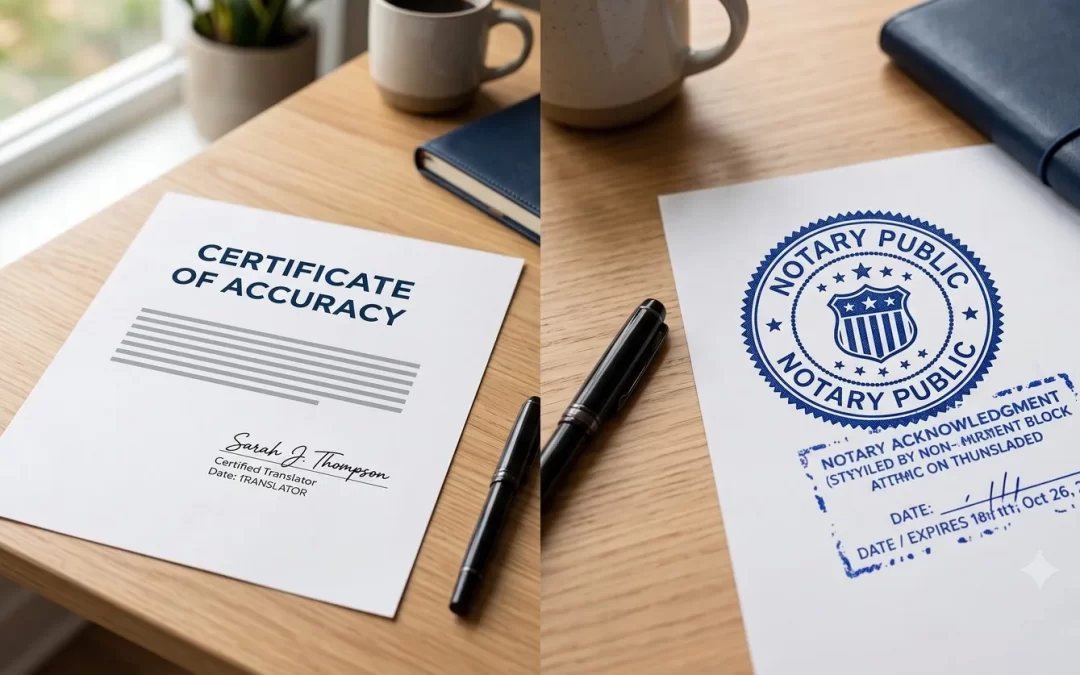
A translator is “considered” certified, for legal purposes, because of a professional declaration — typically called a “Certificate of Accuracy” or “Statement of Certification,” a signed statement attesting that the translation is a true and faithful representation of the original — not because of the translation itself, however complete and accurate a rendering of a source document into a target language that translation may be.
Requirements for a Translator’s Certification
In the United States, and in many other countries, no government license is required for a translator to issue a certified translation — any competent translator can certify their own work and take professional responsibility for its quality, with the weight falling on their expertise and their willingness to stand behind the accuracy of what they produce. Government agencies accept this kind of self-certification, and so do courts.
Components of a Certification Statement
That’s the usual furniture of the thing: a signature, the date the certification was made, the translator’s full name and contact details for whoever did the work — translator or company — so the receiving party can follow up and verify the claim if something looks off, alongside the statement itself declaring the translation complete and accurate to the best of the translator’s knowledge and ability, and sometimes a professional stamp or seal gets affixed as well. Wording and format vary from one country to the next and from one institution’s guidelines to another, but the declaration of accuracy stays the constant underneath — though for certain legal and intellectual property needs, some jurisdictions may require a certified or sworn translator who has been officially appointed by a court or government body.
The Role of Notarization in Translations
The notary public’s job, when a translator signs a certification statement in front of them, is to confirm who is signing — the specific person standing there, signing willingly, not the translator’s identity in some broader sense — which is what makes a notarized translation one step past certification, since the notary isn’t judging whether the translation itself is any good.
What a Notary Public Does
Watching the translator sign the certification statement attached to the translated document, then checking a government-issued photo ID — usually a driver’s license or passport — before applying their own seal and signature is what the notary does, confirming identity and witness in one act, and that extra layer of authentication is often the thing that gets a document accepted for official submissions.
When Notarization is Required
Government agencies and courts often want it, and so do foreign embassies — anywhere a higher level of assurance is needed about who certified the translation. Documents headed for international use run into this most, since the receiving country’s legal system may require the formality. Legal contracts come up often, along with affidavits. It’s a separate administrative step, done after the translation and certification are finished. What it validates is the signer’s identity, not the accuracy of the content.
Key Differences: Certified vs. Notarized
Who makes the declaration, and what exactly are they validating? That’s where certified and notarized translations part ways. Both make a translation official. Their focus isn’t the same, and neither are the people involved. Pick the wrong one and your document gets rejected — so it pays to know which is which.
Defining the Core Differences
The signature is the whole point: a certified translation lives or dies on whether the translated text actually matches the original, not on how smoothly it reads, and the translator’s signed statement is them putting their professional name behind the claim that it does.
A notarized translation turns on the identity of the translator behind the certification statement, and what gets verified is that the signature is authentic and that the person who signed is who they claim to be — nothing about the translation itself, since that’s not the notary’s job.
Purpose and Requirements
The need is for an official rendition that receiving institutions can rely on — a certified translation, whatever else it involves, is a claim about linguistic fidelity backed by a professional’s assurance, which is why converting the words is the easy part.
A notarized translation adds authentication of the translator’s identity — often because an authority requires formal verification of the signer.
A certified translation — a qualified translator’s signed statement of accuracy — is where the requirements start, and in the case of a notarized translation it then has to pass through a notary public, present to witness the translator’s signature and apply their seal; notarization is simply the extra administrative step on top.
Legal Standing and Accountability
Both carry legal weight. Just not for the same things.
Find an error in a certified translation and it’s the translator — or the translation company — who answers for it, because the legal standing of that document rests on the translator’s professional declaration: they’re accountable for any inaccuracies in the content.
The notary checks the signer’s ID — that’s what gives the notarized translation its legal standing and makes the certification statement more credible, since it proves the named translator actually signed it, not someone else. The notary isn’t accountable for the translation’s accuracy, though: notarization adds formal authentication, it does not replace the translator’s responsibility for quality.
When is Each Type of Translation Required?
Get it wrong and your application gets delayed, sometimes rejected outright — so before you order anything, confirm the exact requirements with the institution receiving the documents, since they’re the ones who decide.
Scenarios for Certified Translations
Most official purposes fall under certified translation — anywhere the receiving party wants proof the translation is accurate, backed by a translator’s signed declaration.
- Immigration Applications: Birth certificates, marriage certificates, and documents of that kind often need certified translation for submission to immigration services like USCIS in the United States or the Home Office in the UK.
- Academic Applications: Foreign universities and professional licensing boards want transcripts and diplomas certified before they check the content.
- General Legal Submissions: For evidence or contracts, many courts and legal entities accept a certified translation. They lean on the translator’s signed declaration of accuracy.
- Medical Records: Treatment abroad or an insurance claim — medical histories and reports get requested as certified translations more often than people expect.
Scenarios for Notarized Translations
If a bank or a ministry is on the other side of the deal, they often want the translator’s signature witnessed in person, not just the document, and a notary does exactly that.
- International Business and Legal Documents: Contracts and powers of attorney going to a foreign government may need notarized translation, particularly where the local legal system demands that formality.
- Specific Government Agencies: Agencies handling international affairs or property sometimes request notarization to confirm the translator’s signature is genuine.
- Foreign Embassies and Consulates: Documents submitted to an embassy or consulate for a visa may need notarization, especially if the destination country’s legal system leans on notarized paperwork.
- Certain Educational or Professional Bodies: Less common than certification, but some overseas academic institutions and professional organizations ask for notarized credentials.
Check the requirements with whoever will receive the document. Offices differ, and getting it wrong costs you a resubmission.
Ensuring Accuracy and Compliance
Here’s the thing about certified and notarized translations: get the accuracy wrong and the rest doesn’t matter. A missing line or a mistranslated date can get your document rejected outright, or worse, drag you into legal trouble you didn’t sign up for. So compliance isn’t just about ticking the boxes on the formal requirements — it’s about the linguistic quality of the text itself.
The Importance of Accuracy
A misstated clause in a legal contract, an incorrect date on a birth certificate — errors like these can undermine a document’s validity and cause real problems for the recipient, and since in certified translation the translator attests to the accuracy, expertise and attention to detail carry weight there, while with notarized translations, where the notary only verifies the signer’s identity, the quality of the translation stays the translator’s responsibility.
Meeting Specific Requirements
The procedural side of compliance is where linguistic accuracy alone won’t get you through, because certification wording often has to match exactly and some authorities want a particular type of binding or the statement attached in a specific way — you also need to know the requesting authority’s formal requirements, whether original documents have to be presented, and how the paperwork should be formatted. We work closely with clients to pin those down, offering guidance based on our experience with various international standards and institutional demands; get them right and you avoid rejections and delays.
FAQ
What makes a translator ‘certified’ for legal documents?
There’s one thing a legal translator does that makes the work “certified,” and it isn’t a license or a government exam — it’s a signature on a statement, usually called a “Certificate of Accuracy,” attesting that the translation is complete and accurate. Signing it means the translator takes professional responsibility for the quality of the work, and in many jurisdictions that’s all certification requires: no government license, no outside certification, and yes, a translator can certify their own work.
What is the purpose of a notarized translation?
What a notarized translation verifies is who the translator is, not whether the translation is correct, because the notary public only witnesses the translator’s signature and confirms that the person who signed the certification statement is in fact the translator, which gives the receiving party one more layer of authentication on the signer’s identity.
How do certified and notarized translations differ in their legal standing?
Certified translations rest on the translator’s own declaration of accuracy and completeness, which is what makes the translator accountable for the content. Notarized translations draw their standing from the notary’s verification of identity and signature. Both are official, but they put the legal weight in different places: content on one side, signer identity on the other.
When would I need a certified translation versus a notarized one?
Immigration applications, academic transcripts, general legal submissions — most official purposes call for a certified translation, and the receiving authority’s concern there is that the translation is accurate. A notarized translation is a different animal, usually coming into play when a government agency or foreign entity wants verification of the translator’s identity and signature on top of the self-certification.
What information is typically included in a translator’s certification statement?
The translator’s full name, signature, and date of certification come after the declaration that the rendition is complete and accurate — and in some cases a professional stamp or seal, along with contact details for the translator or the translation company, appears as well.
What are the consequences of submitting an incorrect type of translation?
The receiving authority can reject the document outright, which means you’re paying for the correct translation type twice and waiting through the whole processing time again — and in some cases there are legal complications on top of that. It’s worth checking the specific requirements with the institution that asked for the translation before you submit anything.