 Rana Maalouf
How Much Does Certified Translation Cost?
Certified translation in the United States runs $20 to $45 per page in 2026, or ten to sixteen cents per word. Most shops count a standard page as 250 words. Four things move the needle: document type, language pair, turnaround, and whether the receiving authority wants certification, notarisation or a sworn translator. This guide breaks down those factors with typical market rates by document category, what the same work costs in the UK and Europe, plus the extra fees that surface at checkout.
When comparing quotes, always check whether providers price per page or per word — and what they mean by "page" (usually 250 words). A typical five-page immigration packet will land somewhere between $100 and $225, shaped by the language combination and how fast you need it. Notarization pushes the number higher. Knowing these levers helps you spot real value without gambling on quality when an official body is waiting.
What is a Certified Translation?
A certified translation is not simply a translation that costs more. It is a specific type of deliverable, crucial for official use, particularly for immigration authorities like USCIS. Understanding its components explains most of the price difference between providers. The translation itself has to be complete. Every word on the page: the stamps, the seals, the signature lines, anything scribbled in a margin. No authority that asks for certification will take a summary or an extract of the parts you think matter. With it comes the certification statement. That's a signed page where the translator states the translation is accurate and complete and that they can work in both languages. For USCIS purposes, this certificate of accuracy is a mandatory component, affirming that the translation is a complete and accurate rendition of the original document. And the layout has to track the original closely enough that an officer holding the two side by side can follow one against the other. That last point is where a lot of invisible work sits. A birth certificate is not flowing text — it's a form with boxes, official stamps in a second script, and a registrar's signature. Reproducing that layout faithfully often takes longer than translating the words in it. You are also paying for accountability. If the receiving authority rejects the translation, a professional provider corrects it and reissues the certification. That liability is priced into the rate, and it is the main reason a certified page costs several times what machine translation costs. Every certified translation we deliver carries a guarantee: USCIS and other immigration authorities will accept it. Your application moves forward. No delays over translation hiccups.
What is the difference between certified, notarised and sworn translation?
These three terms get used interchangeably in marketing, and confusing them is the most expensive mistake buyers make — usually by paying for a higher tier than the receiving authority asked for.
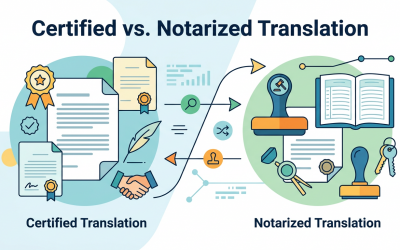
- Certified translation. A complete translation plus a signed statement of accuracy and competence from the translator or agency. This is what USCIS and UKVI require. No third party is involved.
- Notarised translation. A certified translation where a notary public witnesses the translator signing the certification. The notary verifies identity only — they make no judgement about translation quality. It adds cost and a step, and most immigration authorities do not ask for it.
- Sworn translation. A translation produced by a translator who holds official status granted by a government or court, such as a traductor jurado in Spain or a beeidigter Übersetzer in Germany. This is a legal appointment, not a certificate a provider can issue, which is why it costs more and why the translator must be authorised in the specific country.
Notarisation is an add-on to certification, so it costs a bit more. Sworn translation is a different service altogether and priced like one. Find out which of the three your authority actually wants before you start comparing prices, because comparing across the tiers tells you nothing.
How much does a certified translation cost per page?
In the US market, certified translation typically ranges from $20 to $45 per page. Across the US market, a certified page of a common language pair — Spanish, French, German, Portuguese, Italian — runs about $20 to $45. Rarer pairs cost more, sometimes considerably more, because far fewer qualified translators work in them. Providers quote one of two ways, and a quote means very little until you know which: Per page. A flat rate for each page, usually capped at around 250 words. Simple to compare, but you pay the full page rate for a half-empty page. Per word. A rate applied to the actual word count. Fairer on short documents like birth certificates, which often hold well under 250 words. For a short civil document, per-word pricing is usually cheaper. For a dense legal contract, per-page rates can work out better. Neither model is a trick — just check which one a quote uses before comparing it with another.
What does certified translation cost by document type?
Here is the thing most pricing guides get wrong: in the US flat-rate market, the type of document barely moves the price. The major certified providers charge one rate for any document, whatever is printed on it. A birth certificate and a court judgment cost the same per page. What actually drives your bill is how many pages you have. So the useful question is not what does a birth certificate cost but how long is my document. At the $24.95 to $29 per page that US providers currently charge:
| Document | Typical length | Typical total |
|---|---|---|
| Birth certificate | 1 page | $25–$29 |
| Marriage certificate | 1 page | $25–$29 |
| Passport data page | 1 page | $25–$29 |
| Diploma or degree certificate | 1 page | $25–$29 |
| Police or criminal record | 1–2 pages | $25–$58 |
| Academic transcript | 2–4 pages | $50–$116 |
| Divorce decree | 2–5 pages | $50–$145 |
Page counts vary by issuing authority, particularly for divorce decrees and transcripts — a decree from one county may run two pages and five from another. Civil certificates are reliably one page. Where the rate does move is language pair and turnaround, not subject matter. A rare language pair costs more in any document category, and rush delivery costs more on a birth certificate exactly as it does on a contract. Immigration authorities frequently request documents like birth certificates or marriage certificates. Academic diplomas are common too. While their per-page cost stays consistent, knowing their typical length helps you estimate the total cost for your application.
For common language pairs, a 1-3 page document can often be completed within 2 business days. Larger projects, such as 4-10 pages, may take up to 4 business days. Expedited services are typically available for an additional fee if you have urgent deadlines.
What are the going rates in the US market?
Published rates from the main US certified translation providers, checked in July 2026:
| Service | Published US rate |
|---|---|
| Certified translation | $24.95–$29 per page |
| Standard (uncertified) translation | $0.10–$0.11 per word |
| Notarisation | about $20 per order |
| Rush or same-day delivery | $15 per page, or about 35% extra |
| Printed hard copy | $15–$30 |
| Apostille | $79–$105 per order |
A standard page means up to about 250 words across all of these providers, so a document with 400 words on one physical sheet is normally billed as two pages. That definition is worth checking before you compare quotes, because it is where two apparently identical page rates stop being identical.
If you need a specific document, we have dedicated pages for birth certificate translation and marriage certificate translation.
What certification does each authority require?
Price follows requirement. Before you pay for notarisation or a sworn translator, check what the receiving body actually asks for — paying for more than you need is the most common way people overspend on translation.
| Authority | What’s required | Notarisation? |
|---|---|---|
| USCIS (United States) | Certificate of accuracy from a translator competent in both languages | No |
| UKVI (United Kingdom) | Certified translation, typically from an ATC/CIOL/ITI-accredited provider | No |
| IRCC (Canada) | Certified translator, or an affidavit if the translator isn’t certified | Only for the affidavit route |
| Germany | Sworn translator (beeidigter Übersetzer) | No, but sworn status is required |
| Spain | Sworn translator (traductor jurado) | Not if done by an authorised translator |
| France | Sworn translator (traducteur assermenté) | Not if done by an authorised translator |
The practical takeaway: USCIS and UKVI need certification only, so notarisation is an optional extra you can usually skip. Germany, Spain and France need a translator holding official status in that country, which is a different and more expensive service.
What does certified translation cost outside the US?
Prices move with the market, and so does the service you’re buying. In the UK a certified translation means the same thing it does in the US — a complete translation plus a signed statement. In Germany, Spain and France the equivalent document has to come from a sworn translator holding official status, which is a scarcer resource and priced accordingly.
| Market | Typical cost | How it’s priced |
|---|---|---|
| United Kingdom | £30–£45 per page | Flat page rate, or £0.10–£0.18 per word on longer documents. Entry-level offers start around £30. |
| Germany (sworn) | €35–€65 per civil certificate | Usually per standard line at €1–€2, plus a certification fee of €5–€20. |
| Spain (sworn) | €30–€70 per page | €0.10–€0.14 per word for common pairs; the first page often costs more than later ones. |
| France (sworn) | €35–€85 per document | Normally a flat rate per civil-record document rather than per page. |
One thing that catches people out: US prices are typically quoted all-in, while UK and European quotes are often exclusive of tax. Add 20% VAT in the UK and 21% IVA in Spain and a £35 quote is really £42. Check which one you’re being shown before you compare across borders.
The German, Spanish and French figures sit higher than the US and UK ones for a structural reason rather than a market one. A sworn translator is appointed by a court or ministry, the pool is small, and nobody else can produce a document that counts. Where the US and UK let any competent professional certify their own work, those markets restrict who is allowed to, and scarcity shows up in the price.
One thing to be clear about before you compare those numbers with ours. Our prices are for certified translation, which is what the United States, the United Kingdom and Canada ask for, and what a great many European universities, employers and private institutions accept as well. Where a German, Spanish or French authority has specifically asked for a sworn translation, that job has to go to a translator on that country’s official register — and comparing a certified price against a sworn one tells you nothing useful, because they aren’t the same product. Check the wording of your request before you shop on price.
Certified Translation Services
Get your documents translated and certified by a professional translator in 120+ languages with 24 hour delivery.
Get a QuoteUSCIS Certified Document Translation Services
The U.S. Citizenship and Immigration Services (USCIS) requires certified translations for any foreign-language documents when you apply for immigration benefits in the United States. Protranslate specializes in providing USCIS-compliant certified translations so your application proceeds smoothly. Our services meet the strict standards set by USCIS, which include the following:
- A complete, word-for-word translation of the original document.
- A signed certification statement from the translator or translation company, dated and explicit.
- The translator’s name and signature appear alongside their address. They attest to their competence and to the accuracy of the translation.
Guaranteed acceptance for your immigration documents matters. Our process ensures every translation includes the necessary certificate of accuracy. That makes it fully acceptable to USCIS. Need a birth certificate or academic transcript translated? Maybe a marriage certificate or another supporting document? Protranslate provides reliable, affordable, officially certified translations for all your immigration needs.
Why do certified translation prices vary so much?
Language pair
Spanish, French, German and Portuguese into English are the cheapest, because supply is deep. Arabic, Chinese, Japanese, Korean and Russian cost more. Rare pairs — especially ones that don’t route through English — can cost several times the standard rate, simply because only a handful of qualified translators exist.
Turnaround time
Standard delivery for a short civil document is usually 24 to 48 hours. Common language pairs? A one- to three-page document wraps in two business days most of the time. Larger projects — four to ten pages — stretch to four business days. Same-day or overnight service typically adds around 50% to the price. If your filing deadline allows it, standard delivery is the single easiest saving available. Expedited service costs extra when deadlines tighten.
Subject matter
General and civil documents are the base rate. Legal, medical and technical content costs more because it needs a translator who knows the terminology — and because an error carries real consequences. Our legal translation and academic translation services are priced accordingly.
Formatting
Certified translations must mirror the original layout, including stamps, seals and signature blocks. A clean scan is straightforward. A faded photocopy of a handwritten 1960s registry entry takes real work, and some providers bill that separately.
What extra fees should you watch for?
The headline per-page rate is often not the final price. The common additions:
- Notarisation — about $20 per order at the main US providers. Not required by USCIS or UKVI.
- Rush delivery — around $15 per page, or roughly 35% on top of the base price.
- Hard-copy delivery — $15 to $30, more for tracked or international shipping. Most authorities accept a printed digital copy.
- Formatting or “complex document” surcharges — sometimes $5 to $20 per file.
- Apostille — $79 to $105 per order, and only needed when the document is going to a Hague Convention country that asks for it.
- Minimum order charges — some providers apply a floor price regardless of word count, which matters if you only have one short certificate.
Ask for the all-in total before ordering. A $20 page rate with three surcharges is not a $20 translation.
How much does Protranslate charge for certified translation?
A certified translation of a standard one-page document — around 250 words, which covers most birth certificates, marriage certificates and IDs — starts at $24 into English for common language pairs. Translating out of English into another language runs higher, typically $29 to $34, because the pool of qualified certified translators on that side is smaller. That works out to roughly $0.10 per word.
UK customers pay the same rate. At current exchange rates a one-page certified translation into English works out at roughly £18, against a UK market that mostly starts around £30 before VAT — the saving comes from operating outside the UK agency cost base, not from cutting anything out of the document.
The price includes the signed certification statement, formatting matched to your original, and digital delivery. There is no separate certification fee and no charge for the statement itself, which is worth checking when you compare quotes elsewhere — a headline page rate with certification billed on top is a different number than it looks.
You can see the live rate for your own document on our translation cost page, or read more about what’s included in our certified translation service.
Ensuring Official Certification for Legal Documents
For legal documents—especially those for immigration or official purposes—ensuring the translator is officially certified matters. Here's how Protranslate guarantees this:
- We work exclusively with professional translators who are certified by recognized bodies or have proven expertise in legal document translation. They're proficient in both the source language and the target language.
- Every certified translation from Protranslate comes with a signed and stamped Certificate of Accuracy. That document confirms the translation faithfully represents the original, handled by a qualified translator.
- We track the shifting demands of USCIS, UKVI, and similar government bodies. Our certification process reflects those standards, which cuts the chance your paperwork gets kicked back.
- Want to know about our translators' credentials or how we certify? Just ask. We keep everything visible so you'll know your legal documents landed with people who can handle them.
How can you reduce certified translation costs?
- Only translate what’s requested. Check the form instructions. Applicants routinely pay to translate supporting documents nobody asked for.
- Skip notarisation unless it’s required. For USCIS and UKVI it isn’t.
- Send clean scans. A flat, well-lit, full-page scan avoids formatting surcharges and re-dos.
- Order everything at once. Bundled documents usually beat several separate small orders, especially where minimum charges apply.
- Avoid rush service where you can. It’s the largest single surcharge, and it’s the one most within your control.
- Keep the certified translation. It doesn’t expire — the same one can be reused in later filings.
Is the cheapest certified translation worth it?
Not always. A rejected translation costs far more than the difference between providers. If a translation is incomplete or the certification is wrong, USCIS issues a Request for Evidence and your case is put on hold until you respond — months of delay to save a few dollars. Our guide to USCIS translation requirements covers what a compliant certification has to contain.
Before you order, get three answers. Is the certification statement inside the quoted price or billed afterwards? Has the provider filed with your particular authority before, or are they guessing at the format? And if the document comes back needing a correction, who pays for the second version?
There is a real difference between a low price and a cheap one. A provider pricing per word rather than per page will legitimately quote less for a short certificate, because you’re paying for the words that exist rather than a notional 250-word page. That is a pricing model, not a corner cut. What should concern you is a quote that excludes the certification statement, treats formatting as an extra, or is delivered by someone who cannot say which authority the certification format is designed for.
What goes wrong when a translation is rejected?
Most translation-related delays are not caused by mistranslated sentences. They come from omissions and mismatches that are easy to avoid:
- An untranslated element. A stamp on the reverse of the page, a seal in a second script, or a handwritten annotation left out. The translation is then incomplete by definition, whatever the quality of the rest.
- Name spellings that don’t match. If the passport transliterates a name one way and the translation another, the officer sees two different people. Check every name against your passport before filing.
- A certification missing required detail. Some certifications lack the translator’s address, the date, or the explicit statement of competence in both languages.
- Date format confusion. A document written 03/04/2020 means two different dates depending on the country of origin. A good translation makes the intended date unambiguous.
The cost of any of these is not the price of a retranslation. It is the delay: the application pauses while the authority waits for a corrected document, and in immigration cases that pause is measured in months, not days. Reviewing the finished translation against your original for two minutes before filing is the highest-return thing you can do with your own time.
Frequently asked questions
How much does it cost to translate a birth certificate?
A birth certificate typically costs between $25 and $29 in the US market, as it is usually a single-page document. This price can vary slightly based on the language pair and turnaround time.
Is certified translation priced per page or per word?
Providers may quote per page (typically capped at 250 words) or per word. Per-word pricing is often more economical for shorter documents like birth certificates, while per-page rates can be better for dense legal texts.
How much does a certified translation cost in the UK?
In the UK, certified translation typically costs between £30 and £45 per page, or £0.10–£0.18 per word for longer documents. Entry-level offers usually start around £30.
Does a certified translation need to be notarised?
Most immigration authorities, including USCIS and UKVI, do not require a certified translation to be notarised. Notarisation adds an extra step and cost, verifying only the translator's identity, not the translation's quality.
Why is certified translation more expensive than standard translation?
Certified translation is more expensive because it includes a formal certification statement, guarantees accuracy and completeness for official use, and often requires specific formatting to mirror the original document. It also carries accountability if rejected by the receiving authority.
How long does a certified translation take?
For a short civil document (1-3 pages) in a common language pair, standard delivery is usually 24 to 48 hours. Larger projects or rarer language pairs may take longer, and expedited services are often available for an additional fee.
Does a certified translation expire?
No, a certified translation does not typically expire. However, the receiving authority may have specific requirements regarding the age of the original document or when the translation was performed relative to the application date.
Can you shop around for certified document translation prices?
You can. Request quotes from a handful of providers. Check whether they price per page or per word, hunt for buried charges (notarization, rush fees), and confirm they satisfy whatever your receiving authority—say, USCIS—actually demands.
How do I confirm a translator has official certification for legal work?
Look for a signed, dated Certificate of Accuracy that names the translator or agency and vouches for their competence. Some countries require a "sworn translator," which is a legal title, not simply a piece of paper claiming certification.
I need my birth certificate translated and certified for immigration, but I can't overspend. Who handles that?
Protranslate does affordable certified translations for immigration documents—birth certificates included. We meet USCIS compliance rules. A single-page birth certificate usually runs $25–$29, and we list prices up front.
Looking for someone who does official translations for US immigration purposes.
Protranslate handles official translations for US immigration and meets USCIS requirements in full. You get accurate, certified work with a Certificate of Accuracy so immigration authorities accept your documents.
Which services are best for USCIS certified document translation?
The best guarantee acceptance, supply a Certificate of Accuracy, use capable translators, and show you what you'll pay. Protranslate checks every box, with reliable service priced fairly and built for USCIS applications.
What does translating and certifying a 5-page document for immigration normally cost?
In the US, a 5-page certified translation for immigration typically lands between $100 and $225. Final price hinges on the language pair, how technical the content is, and how fast you need it back.
Get a Translation Quote for Your Documents
Do you want a quick and easy way to obtain a professional translation service for your documents? Click on the desired button to access our online translation service!
Get a Quote