 Rana Maalouf
Submitting a document to the UK Home Office in any language other than English or Welsh? You will need a full translation with it, plus a signed and dated statement saying the translation is accurate. Applicants often assume a defective certificate just triggers a follow-up letter asking for a better one. It usually doesn’t. The caseworker records the document as not provided and decides the application on what is left, which on most visa, settlement and citizenship routes ends in refusal.
This guide sets out what the Immigration Rules actually require, who is allowed to certify, what has to appear on the certificate, how the standard changes when you apply from inside the UK, and the mistakes that cost applicants their fee.
What are the UK Home Office translation requirements?
Paragraph 39B of Part 1 of the Immigration Rules sets the standard. It says that where a specified document is in some other language, you have to supply the original as well as a full translation, and that translation has to be something the Entry Clearance Officer, Immigration Officer or Secretary of State can check for themselves.
The translation itself must be dated, and must include:
- Confirmation that it is an accurate translation of the original document.
- The full name and signature of the translator, or of an authorised official of the translation company.
- The translator’s or translation company’s contact details.
- For applications made from inside the UK (leave to remain or indefinite leave to remain): certification by a qualified translator, plus details of the translator’s or company’s credentials.
The same wording is repeated in Appendix FM-SE for the family routes and in caseworker guidance for the work routes, so the standard does not shift depending on whether you are applying as a spouse, a Skilled Worker or a student. What shifts is the fourth element, and only on the basis of where you are physically applying from.
Does the translation have to be into English?
English or Welsh. Both are named in the Rules and both are accepted. Translation into English is the normal choice unless you are dealing specifically with a Welsh-language process.
Does the whole document have to be translated?
Yes. The Rules say “a full translation”, and caseworkers read that literally. Every page, both sides, including stamps, seals, embossed marks, handwritten annotations, marginal notes, revenue stickers and anything printed on the reverse. A summary translation, a translation of “the relevant part”, or a translation that silently drops an illegible stamp is not a full translation. Where something genuinely cannot be read, the correct treatment is to render it and mark it as illegible rather than leave it out.
Which documents need a certified translation for a UK visa?
Anything you are relying on as evidence that is not already in English or Welsh. In practice, the immigration documents that most often need translating are:
- Birth certificates, marriage certificates, divorce decrees and death certificates
- Bank statements, payslips and tax documents used to meet a financial requirement
- Employment letters, contracts and reference letters
- Degree certificates, transcripts and academic references
- Police clearance and criminal record certificates
- Tenancy agreements, title deeds and property documents used as accommodation evidence
- Medical records, vaccination records and TB test certificates where health evidence is required
- Court orders, custody and adoption papers, and name-change deeds
Documents issued bilingually — a certificate printed in both Turkish and English, for instance — do not need translating, provided the English side carries the same information. Documents where only the headings are in English and the substantive entries are not do need translating.
Can I translate my own documents for a UK visa application?
No. The confirmation of accuracy has to come from a translator or a translation company the Home Office can verify independently, and an applicant certifying their own paperwork is the exact scenario paragraph 39B exists to exclude. A caseworker treats such a translation as unverifiable, which puts the underlying document in the same position as a missing one.
The same problem arises with a translation done by a bilingual friend, a relative, or an employer’s office manager. It is not a question of whether their English is good. It is that there has to be a traceable professional identity and a set of contact details on the certificate for the Home Office to check.
Who can certify a translation for the Home Office?
A professional translator, or an authorised official of a translation company, giving their full name, their signature and contact details so the certification can be verified. That is the whole test.
Does the translator need to be a member of the ITI, CIOL or ATC?
No rule in the Immigration Rules requires membership of any particular body. Paragraph 39B asks for a qualified translator whose credentials can be verified; professional membership is one way of evidencing that, not a legal condition of acceptance. Providers who tell you the Home Office only accepts ITI, CIOL or ATC members are describing their own marketing, not the Rules.
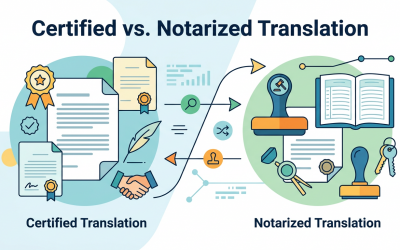
Does the translation need to be notarised?
No. Paragraph 39B contains no notary requirement, and a notarised translation carries no extra weight with a caseworker than a properly certified one. Notarisation confirms the identity of the person who signed a document. It says nothing about whether the translation is correct, which is the thing the Home Office is actually asking about.
Does the translation need an apostille or legalisation?
Not for a Home Office submission. An apostille may separately be required on the original foreign document by whichever authority issued it or asks to see it, and that is a document-legalisation question entirely separate from translation. The translation itself does not get apostilled for UKVI purposes.
Does the translator have to be based in the UK?
No. Nothing in the Rules requires a UK-based translator or a UK-registered company, and nothing requires the certificate to be issued on UK letterhead. What matters is that the certification is complete and that the contact details on it are real.
Is there such a thing as a sworn translator in the UK?
The UK has no system of court-sworn translators, unlike France, Spain, Poland or Turkey, where a translator is registered with a court and holds a personal seal. If a UK-facing provider is selling you a “sworn translation” for a Home Office application, they are selling something the Home Office does not ask for and cannot use. Certified is the correct product for UKVI.
Sworn translation still matters in the other direction: if you are sending a UK document to a foreign authority that operates a sworn system, that authority may well require one.
What must the certification statement say?
GOV.UK’s guidance on certifying a document puts it in plain terms: ask the translator to confirm in writing on the translation that it is a “true and accurate translation of the original document”, along with the date and their full name and contact details.
A compliant certificate therefore contains:
- A declaration that the document is a true and accurate translation of the original
- The date of the translation
- The full name of the translator, or of the company official signing on its behalf
- That person’s signature
- Contact details for the translator or company
- For in-UK leave to remain and indefinite leave to remain applications, the translator’s credentials
Wording along these lines satisfies it:
I, [full name], confirm that I am competent to translate from [source language] into English, and that the attached document is a true and accurate translation of the original [document type] issued to [document holder’s name].
Signature: ______________________
Name: [full name]
Credentials: [qualification, professional membership or company position]
Company: [company name]
Address and contact: [address, email, telephone]
Date: [date of translation]
Keep the certificate attached to the translation. A translation circulating on its own, without the signed statement, is not a certified translation, whatever it says in the file name.
Certified Translation Services
Get your documents translated and certified by a professional translator in 120+ languages with 24 hour delivery.
Get a QuoteIs the requirement different for applications made inside the UK?
Yes, and this is the detail applicants miss most often. For leave to remain and indefinite leave to remain — applications made from within the UK — paragraph 39B adds two elements on top of the general standard. The certification has to come from a qualified translator, and it has to state the translator’s or company’s credentials.
A certificate perfectly adequate for an entry clearance application made abroad can therefore fall short on an in-country application, purely because it names the translator without describing their qualification. Nothing else about the document is wrong. It simply doesn’t answer a question the Rules ask on that route.
Tell your translation provider where you are applying from before they issue the certificate. Adding a credentials line at the drafting stage costs nothing. Getting it added after a refusal costs a fresh application fee.
What happens if the translation is missing or non-compliant?
Home Office caseworker guidance is direct about this: where no certified translation is supplied, or the translation cannot be independently verified, the document is not accepted and the application is considered as though the applicant had not provided that document at all.
That consequence lands hard because UK routes are evidence-driven and largely mechanical. A bank statement that drops out of the bundle means the financial requirement is not met. A marriage certificate that drops out means the relationship is not evidenced. A police certificate that drops out means a mandatory document is missing. The caseworker is not obliged to write and ask for a better translation first, and on a points-based route there is often no discretion available even if they wanted to exercise it.
The practical cost is the application fee, the Immigration Health Surcharge timing where it applies, and on in-country routes the risk to your existing leave while a fresh application is prepared. A refusal for a certification defect also sits on your immigration history, and future applications ask about previous refusals.
The defects that cause this most often
- An undated certificate
- A typed name with no actual signature
- No contact details, or a dead email address
- No credentials line on an in-country ILR or leave to remain application
- One blanket certificate covering a bundle of documents, rather than a certificate per document
- Stamps, seals or the reverse of a page left untranslated
- The translation submitted without the original-language document alongside it
- Names transliterated one way on the birth certificate and another way on the marriage certificate
How do I get documents translated for the Home Office?
Step 1: Collect and scan the originals properly
Scan every page and both sides at full page size, with all stamps and seals legible. Phone photographs taken at an angle are the most common cause of an avoidable query. If a document is folded, flatten it before scanning.
Step 2: Choose a provider that certifies each document separately
Ask before you order whether you get a certificate per document or one statement covering the batch. Per document is what you want, because you will often reuse a single translation on a later application without the rest of the bundle.
Step 3: Say which route you are on and where you are applying from
Entry clearance from abroad and leave to remain from inside the UK do not carry the same certification requirement. Your provider cannot guess which one applies to you.
Step 4: Check the delivered translation before you upload it
Read it against the original for names, dates, document reference numbers and place names. Check that every name is transliterated exactly as it appears in your passport, and that it is transliterated the same way across every document in the bundle. Inconsistent spellings of the same person’s name across documents generate caseworker doubt out of all proportion to the actual error.
Step 5: Upload the original-language document alongside the translation
Paragraph 39B asks for both. Uploading only the English version is a complete answer to nothing.
How much does a certified translation for the Home Office cost?
Protranslate prices certified translation by word count rather than per page, which works out cheaper on short civil-status documents than the flat per-page rates common in the UK market. Certified translation starts from around £0.024 per word (about $0.03) on standard delivery, with express options from roughly £0.04 per word (about $0.05). A single-page birth or marriage certificate therefore comes in well below a typical UK per-page quote. The final figure depends on the language pair, the volume and how fast you need it.
How long does a certified translation take?
Standard delivery on short civil documents is 1–2 business days, with express delivery inside 24 hours where a biometrics appointment or an application deadline is close. Longer evidential bundles — a year of bank statements, a full academic transcript — take proportionally longer, so order those first rather than last.
Will the Home Office accept a digital PDF?
Yes. UK applications are made online and evidence is uploaded, so a signed, dated PDF certificate is what almost every applicant needs. Order hard copies only where a specific process asks for wet-ink originals, which in practice means some court, registry and consular submissions rather than the standard UKVI application route.
Frequently asked questions
Does a certified translation expire?
No rule gives a certified translation an expiry date. The certificate attests to the accuracy of a translation of the document as it stood on the date of translation, so it stays valid as long as the underlying document is unchanged. If the source document is reissued, amended or superseded, the new version needs its own translation.
Can I reuse the same translation for a later application?
Yes, provided the source document has not changed and the signed certificate travels with it. One point to check: if the first application was entry clearance from abroad and the next is an in-country leave to remain or ILR application, confirm the certificate states the translator’s credentials, because that element is only required on the in-country routes.
Do stamps, seals and handwritten notes have to be translated?
Yes. They are part of the document and a translation that omits them is not the “full translation” the Rules require. Where a stamp is genuinely unreadable, the translator marks it as illegible in place rather than leaving a silent gap.
My document is handwritten and hard to read. Is that a problem?
It slows the work rather than blocking it. Older handwritten civil registry entries are routine translation material. Passages that cannot be deciphered are marked as illegible in the translation instead of being guessed at, which is what a caseworker expects to see.
What if my name is spelled differently on different documents?
Tell the translator which spelling appears in your passport and ask for that spelling to be used consistently, with the original-script form shown where it differs. Inconsistent transliteration across a bundle is one of the most common triggers for caseworker doubt about whether the documents relate to the same person.
Do I have to post the original paper documents to the Home Office?
For a standard online application you upload scans, and paragraph 39B is satisfied by uploading both the original-language scan and the translation. Some routes and appointment types ask to see original documents in person, so check the document checklist generated for your specific application.
Does a certified translation guarantee my visa will be granted?
No. It satisfies the translation requirement in paragraph 39B and nothing beyond it. The substance of your application — eligibility, finances, relationship, immigration history — is assessed entirely separately.
Is the Home Office standard the same as the USCIS standard?
They are close but not identical. Both accept a certified translation, and neither requires a notary or a sworn translator. USCIS asks the translator to certify their competence to translate; the Home Office asks for a signature and contact details, and for in-UK applications also the translator’s credentials. Our guide to certified translation for USCIS covers the American requirement in full.
Get a Translation Quote for Your Documents
Do you want a quick and easy way to obtain a professional translation service for your documents? Click on the desired button to access our online translation service!
Get a Quote