 Rana Maalouf
Cross-border use of documents has become a norm for individuals, business entities, and institutions. Whether applying for immigration, enrolling in educational institutions, or undergoing any kind of legal process, documents have to be submitted in a language other than their original version. In these situations, accuracy leaves no room for interpretation. The translated document must reflect the original wording exactly, without shifts in meaning. This is where certified translation comes in.
Topics covered
- The definition of certified translation
- Statement of translation accuracy
- Documents which need certified translation
- Conformance requirements
- Sworn vs. Official vs. Certified Translations
- The differences in country-specific terminology
- How to obtain a certified translation
- Typical Use Cases
- Disadvantages of certified translation
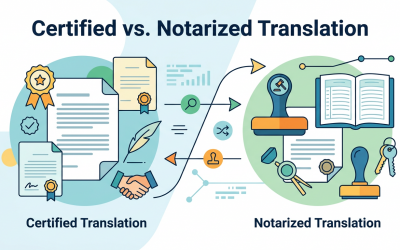
- Notarized translation explained
- Cost considerations
- The global compliance
- International self-certification Rules
Certified Translation Services
Get your documents translated and certified by a professional translator in 120+ languages with 24 hour delivery.
Get a Quote
What is a Certified Translation?
A certified translation can be defined as a translated document that has a signed statement by a professional translator or translation company to the effect that the document has been translated fully and accurately. The signed statement also affirms that the document has been translated by a person who has full competency in the original as well as target languages.
This attestation is called a Statement of translation accuracy. This signed attestation indicates the translator or agency’s responsibility for the accuracy of the translation itself. The responsibility for the contents, however, is with the person who owns the document.
A translation will be deemed to be certified when it contains the following:
- A true and complete translation of the source text
- A signed document acknowledging accuracy and completeness
- The translator’s credentials and contact information
The critical difference between an ordinary translation and an authentic one has to do with the presence of this signed certification statement. Ordinary translations can indeed contain correct translations without being authentic.
Statement of translation accuracy
Statement of translation accuracy: It is an accompanying document that affirms the accuracy of the translation. It typically includes details on company letterheads, with special identification information.
A complete certificate generally covers:
- Translator’s Information – Name, professional background, and contact details
- Accuracy statement: A declaration to confirm if the translator possesses skills in handling both languages to ensure its equivalence in translation.
- Date of completion – The date of finalization of translation.
- Signature
- Handwritten or secure electronic signature
- Stamp or seal – If possible, a stamp from the translator or the translating agency.
- Document identification – Title, date, or reference numbers of the original document
- Intended use (optional) – This may reveal what sort of document it is, for example, for judicial, academic, immigration, or medical use
Documents that Require Certified Translation
When documents are submitted to a foreign authority, the possibility of language limitations restricting proper assessments exists. This can be corrected with certified translations.
Certified translations are commonly requested for documents such as:
- Immigration and visa requirements
- Courthouse filings
- Admittance to government applications
- Adoption cases
Common examples include:
- Birth certificates
– Required for visa applications, residency permits, and civil registration
Document Translation Services
Looking for a Quick and Convenient Way to Get Professional Document Translation Service? Click the Button Below for Our Online Translation Service!
Get a Quote
- Birth certificates – Commonly requested for visa filings, residence permits, and official civil records.
- Marriage certificates – Used in family reunification cases and to confirm a legally recognized relationship.
- Academic documents – Diplomas, transcripts, and certificates reviewed by schools and universities.
- Legal paperwork – Contracts, court rulings, affidavits, and powers of attorney.
- Immigration documents – Background records and civil documents examined by immigration officials
- Business agreements – Contracts and corporate documents used in cross-border business
Translation Certification Criteria
A certified translation to be accepted by government agencies must have the following characteristics:
- Qualified translator or agency – The certification needs to be given by a professional translator or an agency that is approved by the concerned authorities or organizations such as ATA or ITI.
- Verifiable Credentials – Service providers should be included in professional directories organized by an organization such asCIOL or ATC respectively.
- Complete Accuracy – It must include every aspect of the original document without appending anything to it.
- Correct Formatting – Some organizations may require a certain formatting or form of documentation.
- Language proficiency – The translator has to be highly proficient in both languages
- Confidentiality Safeguards – Secure handling of documents & data protection steps
- Subject-specific expertise – Legal, medical, and technical texts require translators familiar with the relevant field.
- Certificate of Accuracy – A signed declaration confirming that the translation matches the original document.
Sworn, Official, and Certified Translations: Main Differences
Sworn Translation
A sworn translation is the work of a translator who has been officially authorized by a government institution, sometimes by the court. Sworn translators have taken an oath and have the ability to sign the translation using their official seal. Sworn translations have the same validity as the source document in the jurisdiction.
Sworn translations are usually needed for:
- Court submissions
- Government filings
- Citizenship applications
- Overseas academic recognition
It has legal validity, official stamps, and recognition of public institutions.
Official Translation
The phrase “official translation” is commonly used informally. In this case, it might refer to either sworn or certified translation, depending on the regulations within the relevant jurisdictions. Here, the deciding feature is whether it has gained acceptance with the concerned authority.
Certified Translation
The certified translation comes along with an accuracy certification and is not provided by an appointed translator. Although recognized universally, it has equal status as that of a sworn translation in countries that practice sworn translators.
Local Terminology for Certified Translations by Country
Terminology varies by region, and regional requirements include:
United States: Generally known as USCIS certified translation for immigration purposes
France: Traduction assermentée, issued by court-sworn translators
Español: Traducción jurada, de acuerdo con el Ministerio de Asuntos Exteriores
Australia: NAATI-authorized translations
Canada: Regulated translation requirements are at the province level
Switzerland: Translations certified by translators and notarized or attorney-verified
Ireland: Certified translations by recognized professional members
Austria: COURT-CERTIFIED translators authorized by the Ministry of Justice
Germany: Beglaubigte Übersetzung, created by court-approved translators
Russia: Notarial translations involving notarization
Let the Words Lead the Way!
Have your document translated into more than 100 languages by professional translators with just a few clicks without ever stepping a foot in a translation office.
Get a Quote
Ways to Get a Certified Translation
The procedure typically entails the following:
Verification of requirements – Ensure whether an approved, sworn, or notarized translation is required
Documents submission – Ensure you provide a clear copy to a qualified provider
Translation and review: “Translation is completed and checked for accuracy” (DOJE).
Certification: A certificate of accuracy has been signed.
Notarization (if required): Signature of certification is notarized
Delivery: Final certified documents are made available
Common Use Cases
- Immigration and residence applications
- University Admissions
- International contracts
- International
- Proceedings abroad
- Medical service abroad
- Property transactions
- Adoption process
- Advantages of Certified Translation
- Credibility – Recognized by official institutions
- Error-proofing/accuracy assurance – Prevent misinterpretation Attempts to ensure
- Long-term savings – Avoids delays, rejections, or repeated submissions
What is a Notarized Translation?
In a notarized translation, a notary public is involved to confirm the signer’s identity and to authenticate the signature. The notary’s role is limited to this verification and does not extend to checking the translation’s content.
Cost of Certified Translation
Pricing is influenced by the following:
- Document length
- Language pairing
- Subject complexity
- Urgency
Some companies charge by the word, while others by document. This should be asked in advance.
Are Certified Translations Accepted Everywhere?
Acceptance relies upon the accepting authority. Norms and standards differ across countries and institutions.
Can You Certify Your Own Translation: Self-certification is not normally acceptable for official purposes. A third-party verification by a competent person is required in order to avoid bias.
With this era of globalization and the internet, those days are over when you must visit a physical office address to get your personal documents translated. All of our translations are done by professional certified translators, making them official for government agencies, universities, courts, and embassies around the world. Protranslate is one of the leading certified translation companies and always here to provide professional services no matter where you are.
Online delivery also makes the process even more convenient, where you can receive your certified translations on time and in the required format of institutions. The process is simple:
Step 1: Upload Your Document (2 minutes). Simply upload using our secure online system. PDF, DOC, JPG, PNG, and 70+ common file types accepted. And choose the language combination.
Step 2: Get Instant Price Quote. Learn the translation price right away based on document length and by language pair. No extras, no surprises.
Step 3: Professional Translation. Your file gets sent to an expert translator who is a native of the target country and is familiar with the type of file you have.
Step 4: Quality Review. Another linguist verifies the translation for accuracy, terminology, and formatting.
Step 5: Certification and Delivery. Your professionally completed translation carries an official certificate of accuracy and is issued as a PDF fit for submission.
You are all set! Contact us today to get more information about our online certified translation service.
Get a Translation Quote for Your Documents
Do you want a quick and easy way to obtain a professional translation service for your documents? Click on the desired button to access our online translation service!
Get a Quote