 Rana Maalouf

Differences Between Sworn, Judicial and Legal Translation
Sorting out official document translations gets tricky. Terms like “sworn,” “certified,” “judicial,” and “legal” get thrown around, and they often overlap. But you need to know what each means for authorities to accept your papers. This guide clears up the main differences between sworn and certified translations; people confuse them all the time. I’ll also touch on judicial and legal translation, giving you a full picture of how translation and law intersect. Want more detail on various legal translation needs? Check out our legal document translation services.
What is a Sworn Translation?
When a document needs to be translated for official use, you’re usually looking at a sworn translation: it’s what happens when a government-authorized translator (someone who’s taken an oath and been recognized by, say, a Ministry of Foreign Affairs or a court) not only translates the text but also formally attests that their translation is a precise, word-for-word match of the original.
Typically, the sworn translator’s signature, seal, and a formal declaration of accuracy go on the translated document. That gives it legal weight in specific jurisdictions. What it is, is a document that is signed by a sworn translator who is authorized by the foreign office to translate these types of official documents. What this provides, is that all documents under a sworn translation hold formal status with the authorities.
What is a Judicial Translation?
A judicial translation is any translation relating directly to a document that is part of a judicial proceeding. So for example sentences, property deeds, lawsuits etc. However, this also includes documents such as marriage certificate translation for a couple filing for divorce lets say. We make these translations for courts, tribunals, or other legal proceedings. They often need specific legal terms and procedures followed exactly.
What is Legal Translation?
A legal document translation is translating texts that are somehow related to law from one language to another. So legal translation services include translating legislative text, lawful agreement, law manual, article on legal themes, anything related to law and educational textbooks. This wide category covers lots of documents. Contracts, patents, regulations, court papers. All sorts. Precision is critical in legal translation. Even small errors can have big legal consequences. Complex international legal and compliance documents often need specialized know-how. Protranslate has legal translation services that handle these demands.
What is a Certified Translation?
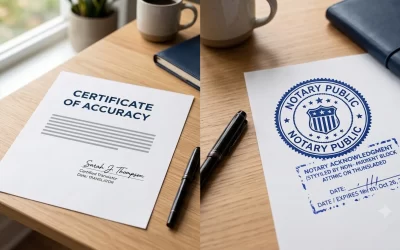
Submit official documents to governments, schools, courts, or banks. They often demand a certified translation. That gives your document legal weight. It confirms the translation truly reflects the original. A certified translation includes a signed statement from the translator or agency. It attests to the translation’s accuracy and completeness. This statement, often called a “Certificate of Accuracy,” confirms the translation truly reflects the original document. Certified translations don’t always require a government-sworn translator. Instead, the certification comes from the translator’s or agency’s professional standing and declaration.
Key Differences: Sworn vs. Certified Translations
Understanding the core distinctions between sworn and certified translations is essential for choosing the right service for your needs. While both aim to provide official, accurate translations, they differ significantly in authority, legal recognition, and the process involved.
| Feature | Sworn Translation | Certified Translation |
|---|---|---|
| Authority | A “sworn” or “public” translator handles this, authorized by a government agency. Think a Ministry of Foreign Affairs, or a court. | A professional translator or agency does it. They just give a signed statement saying it’s accurate. |
| Legal Validity | It holds formal legal status in certain countries, mainly those with civil law systems. Germany, Spain, Turkey, for instance. | Generally, common law countries accept these for official stuff. The USA, UK, Canada come to mind. |
| Process | The translator takes an oath, puts their official seal or stamp on it, then signs a formal declaration. | The translator or agency provides a signed Certificate of Accuracy. Often it’s on company letterhead. |
| Acceptance | Often you’ll need one for legal proceedings, immigration, and academic recognition. This is true in places that recognize sworn translators. | These are widely accepted for immigration, academic applications, and administrative tasks in many countries. |
| Cost & Turnaround | Can be pricier, since it requires specialized authorization. Turnaround times vary, depends on if a translator is free. | Generally more affordable and quicker. But if you need it fast, that could bump the price. |
| Primary Use Case | Documents for government agencies, courts, or universities. Specifically in civil law places. | Documents for USCIS, universities, employers, or other institutions in common law places. |
Sworn vs. Certified Translations: Elements of Sworn and Certified Translations
The bedrock of a sworn translation’s unimpeachable authenticity, particularly in civil law countries, comes directly from the translator’s legal authority. Certified translations also aim for that high bar, but their process reflects the common law systems they operate within, a fundamentally different approach.
Common Elements:
- Statement of Accuracy: This is a declaration. It confirms the translation is complete and accurate, as far as the translator knows.
- Translator’s Signature: Just the personal signature of whoever did the translation.
- Translator’s Identification: Usually includes the translator’s name, their contact details, and any professional qualifications.
- Date and Location: The day the translation wrapped up and where it was issued.
- Original Document Reference: A clear note pointing back to the original document that got translated.
Differentiating Elements:
- For Sworn Translations: These almost always feature an official seal or stamp from the sworn translator. You’ll also see their registration number. And there’s a specific formal declaration or oath, which the authorizing government body requires. Visually, they look more official.
- For Certified Translations: These usually come with a “Certificate of Accuracy.” It’s typically on the translation company’s letterhead, stating the translation is true and accurate. Sometimes a notary public will notarize the translator’s signature, but that’s a separate step. It’s not part of the certification itself.
When is a Sworn Translation Required?
When you need to submit a document to government agencies, courts, or universities, particularly in civil law jurisdictions, you’ll often find they require a sworn translation. These translations carry significant legal weight since the state officially recognizes the translator’s authority, making them an essential part of legal and administrative processes.
You’ll often need a sworn translation in a few common situations:
- Immigration Documents: Think birth certificates, marriage certificates, or even divorce decrees. Also criminal record checks. These are often for visa applications or residency permits in places like Germany, France, or Spain.
- Legal Proceedings: Any document presented as court evidence. Things like contracts, wills, or legal judgments. Especially in European and Latin American countries.
- Academic Recognition: Diplomas and transcripts. Also academic records for university admissions or professional licensing. This applies to jurisdictions that specifically require sworn translations.
- Business and Corporate Documents: Articles of incorporation, power of attorney, and financial statements for international business operations or legal compliance in certain countries.
You’ll always want to verify what the requesting authority specifically requires, since regulations can really vary: not just country-to-country, but even by institution within the same country.
When is a Certified Translation Sufficient?
You’ll find certified translations are widely accepted, certainly in common law countries like the United States, the United Kingdom, Canada, and Australia, but also for plenty of international administrative needs. They’re usually enough when all that’s required is a professional translator’s (or agency’s) official declaration that the translation is accurate, without needing a government-appointed “sworn” translator.
You will typically find a certified translation sufficient for:
- Immigration Applications: Documents submitted to immigration authorities like USCIS in the United States, including birth certificates, marriage licenses, and passports.
- Academic Applications: Transcripts, diplomas, and other academic documents for university admissions or credential evaluation.
- Employment Verification: Foreign degrees, professional licenses, or reference letters for job applications.
- Financial Institutions: Bank statements, loan agreements, or property deeds for banking or investment purposes.
- General Administrative Use: Any situation where an official, verifiable translation is needed, but the legal framework does not demand a sworn translator.
You’ll want to confirm the receiving institution’s exact requirements before getting a certified translation, though they’re generally accepted, because it’s always best to ensure compliance.
Where Protranslate Comes In
Have more questions about legal document translation services vs. certified document translation services? Protranslate offers expert help with sworn and certified translations. Protranslate offers legal translation online in addition to a variety of other services including notarized translation if you are looking for notarized translation services, to apostille translation should those be your needs even to subpoena translation. Our team makes sure your official documents meet any jurisdiction’s specific needs. You get accurate, compliant translations.
FAQ
What is the difference between sworn and certified translations?
The key difference boils down to the translator’s authority and, really, the translation’s legal standing. In civil law countries especially, a sworn translation comes from a translator officially authorized by some government body and carries formal legal status. A certified translation, on the other hand, is just accompanied by a statement of accuracy from a professional translator or agency; it’s widely accepted for official purposes, mostly in common law countries.
What is a sworn translation?
A sworn translation is one where the translator doesn’t just translate the document, but formally attests to it, giving it legal validity in specific, often civil law, jurisdictions. This means a sworn translator, officially authorized by a government body, stamps each page with their seal, signs it, and includes a formal declaration of accuracy and fidelity.
What is a certified translation?
Common law countries, however, typically require a certified translation, which is just a “Certificate of Accuracy” signed by the translator or agency themselves. It’s a statement vouching for the translation’s completeness (that it’s a true rendition of the original document) and it’s widely accepted for official purposes.
What are the elements of certified and sworn translations?
Both types of translation are signed, identified, and dated by the translator, with a reference to the source document, but you’ll know a sworn translation by its official seal or stamp and a formal declaration from a government-authorized professional. A certified translation will have a similar statement of accuracy, of course, but it’s presented on company letterhead.
What is an apostille?
When you need a document to cross international borders, particularly for countries signed onto the Hague Apostille Convention, you’ll need an apostille: it’s a certificate, issued by a country’s designated authority, that essentially vouches for the seals and signatures on public documents. It’s not a translation, mind you, its job is solely to verify the legitimacy of the signature or seal of the official who issued the original document, thus making it valid for use abroad.
What is the Hague Convention and how does it relate to apostilles?
Often called the Apostille Convention, the Hague Convention Abolishing the Requirement of Legalisation for Foreign Public Documents is the international treaty that cuts through all the red tape around authenticating documents for use abroad. That’s because member countries have all agreed to recognize an apostille as sufficient authentication, which means you won’t need any further legalization by embassies or consulates.
How do different countries handle sworn vs. certified translations?
Whether a country operates under a civil law or common law system dictates its translation requirements. In civil law countries like France, Germany, or Spain, you’ll almost certainly need a sworn translation, one performed by a translator specifically appointed by the state. Common law countries, on the other hand (think the USA, the UK, or Canada) are generally more flexible; they’ll accept a certified translation from any qualified professional translator or agency, provided it’s accompanied by a [Certificate of Accuracy].
What documents commonly require sworn or certified translations?
Any official record, from a birth certificate to a will, needs a certified translation, even academic transcripts, diplomas, contracts, immigration forms, or court documents. Whether you need a sworn translation or just a certified one really depends on the authority asking for it and where it’s destined.
What is the difference between sworn and judicial translation?
When a translation needs to hold up in court, you’re looking at a judicial translation, specifically prepared for legal proceedings, think court cases, tribunals, or arbitrations. This isn’t necessarily the same as a sworn translation, which speaks to the translator’s official accreditation and the translation’s formal validity for official purposes generally. Depending on the jurisdiction, a judicial translation might need to be sworn, but not always.
What is the difference between judicial and legal translation?
Legal translation is an umbrella term for texts like a contract, a patent application, or even legislative texts, anything, really, that touches on the law. Judicial translation is a specific subset of that, reserved for documents explicitly intended for court or judicial proceedings, whether that’s a lawsuit, a judgment, or pieces of evidence. So while every judicial translation is, by its nature, a legal translation, not every legal translation will find its way into a courtroom.
What is legal translation?
Translating legal texts from one language to another demands a specialized grasp of both the source and target languages’ terminology and concepts, it’s not just about words, it’s about the law behind them. You’ll often find yourself working with everything from intricate contracts and patents to legislative texts, or even academic articles exploring legal themes.
Can any translator provide a sworn translation?
Only translators officially authorized (or “sworn in”) by a government body or court in a specific country can provide a sworn translation, a critical distinction because it’s their formal oath that ensures the document’s fidelity. This authorization usually means passing rigorous exams and meeting specific qualifications, setting them apart from other legal translation specialists.
Do I need a sworn or certified translation for my visa application?
You’ll find that whether you need a sworn or certified translation for your visa application is entirely up to the destination country, and often, even the specific embassy or consulate. For instance, some countries are really strict about this and others, not so much. Your best bet is always to check the official guidelines from the immigration authority or embassy you’re applying to, because these requirements can really vary a lot between different jurisdictions.
What is the difference between a sworn translator and a notary public?
Think of it this way: a sworn translator is the one actually translating and then certifying a document’s accuracy, imbuing it with legal validity in specific countries. A notary public, on the other hand, isn’t translating a thing; they’re a legal professional witnessing signatures, administering oaths, or certifying other documents. While a notary can certainly notarize a translator’s signature on a certified translation, that’s a distinct administrative step from the translation’s own certification.
How long does a sworn translation take?
How long will it take? That’s always the kicker, isn’t it? A sworn translation invariably takes longer than a standard translation, not just because it’s a specialized process, but because you need to find a sworn translator available for your specific language pair. That alone can be a hurdle, and then you have to factor in the document’s length and complexity. Usually, you’re looking at anywhere from a few days to over a week.
How long does a certified translation take?
Unlike sworn translations, certified translations often come back much faster, think 24 to 48 hours for a standard document, though how quickly depends on its length, how tricky the source material is, and, of course, the agency’s workload. If you’re really in a bind, most outfits offer urgent services to shave off even more time.
Certified Translation Services
Get your documents translated and certified by a professional translator in 120+ languages with 24 hour delivery.
Get a Quote